|
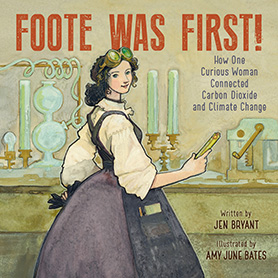
| Foote Was First! |
|
| How One Curious Woman Connected Carbon Dioxide and Climate Change |
|
written by Jen Bryant
illustrated by Amy June Bates
Published by Quill Tree Books, an imprint of Harper Collins
ISBN 9780062957061, hardcover $19.99, 40pp.
Ages 4 and up
On sale 13 January 2026 |
|
| Eunice Newton Foote was a pioneer in climate science at a time when women were excluded from scientific discussions, publications and organizations. But she was the very first person (although someone else claimed that HE was the first!) to prove the link between carbon dioxide in our atmosphere and a warming Earth. Foote Was First shares the story of her childhood, education, marriage, motherhood and participation in the Seneca Falls Women’s Rights convention — and how her experiments proved the process known today as the greenhouse effect. |
|
| Resources |
|
| Watch the feature SHORT FILM “Eunice,” written by Randi L. Hanson & Moira James-Moore; dir by Eric Garro; starring Holly Lawton, Oliver Hembrough, Helen Jessica Liggat. |
|
|
|
| Read "In Conversation: Jen Bryant, Rebecca Donnelly, and Lindsay H. Metcalfe on Eunice Foote," Publishers Weekly, 22 January 2026. |
| |
| "Eunice Foote—the Nearly-Forgotten Mother of Climate Science," Hidden Voices, New York Public Schools, April 22, 2025 |
| |
| Read Eunice Foote’s “Circumstances Affecting the Sun’s Rays” in the American Journal of Art and Science, November 1856. |
|
| Read the text of the Declaration of Sentiments, signed by 68 women (Eunice is #5) and 32 men, at the First Women’s Rights Convention in Seneca Falls, NY, July 20, 1848. |
|
| Climate.gov/NOAA celebrates Eunice Foote as a “hidden science climate pioneer.” |
|
| From the Michigan Department of Environment, Great Lakes, and Energy, "Eunice Newton Foote," a storymap. |
|
| Enjoy the Google Doodle, published on July 17, 2023, Eunice Foote’s 204 birthday! |
|
| Chemist E. Dovrou explains why Foote’s research remains “strikingly relevant.” |
|
| Reviews |
|
| While climate change and global warming are discussed and understood by scientists now, when was that connection uncovered? While it is credited to John Tyndall in 1861, Eunice Newton Foote, a true scientific pioneer, was the first person to make that scientific discovery, in 1858. The artwork is gorgeously soft and tinged with yellow and green hues that set this story in the 1800s at a laboratory dedicated to discovering the connection between carbon dioxide and how it traps the sun’s heat in our atmosphere. Foote’s story begins with her general curiosity and continues all the way to her schooling, marriage, and family life, then to her major scientific discovery. The book acknowledges that there is no complete record or evidence of Tyndall ever reading Foote’s work but does speculate that as a woman and an American, Foote and her accomplishments were not widely lauded. The book ends on a hopeful note about climate change and women in science. Among the back matter is a time line, a glossary, and a bibliography. VERDICT An excellent picture book biography that amplifies one of the unsung heroes of science. (School Library Journal, Molly Dettmann) |
|
|
|
| Eunice Newton Foote (1819-1888) was the first to document the effect of greenhouse gases on Earth’s climate.
Eunice’s sense of curiosity—undiminished by the misogyny of her era—anchors this picture-book biography as Bryant takes her subject from a child inquisitive about life on the family farm and beyond to a young adult who eagerly studied botany, chemistry, and geology at boarding school in Troy, New York. Foote’s questioning mind extended to social issues; after marrying and settling down in Seneca Falls, she attended the first women’s rights convention in the U.S. in 1848. She knew women were just as capable as men and pursued her passion for science. Her discovery that increased carbon dioxide in the air resulted in higher temperatures still informs our understanding of global warming. Five years after she published her paper, however, the Irish physicist John Tyndall would claim he was the first to make that discovery; acknowledging that he may have been unaware of Foote’s work, Bryant mildly notes, “Like most men in those days, the professor believed that women were not curious and could not learn science.” Though skimming over some details of Foote’s life and work, Bryant’s straightforward prose pairs well with Bates’ earth-toned, impressionistic watercolor and colored pencil images. Billowing images of smoke and gases escaping volcanoes echo Foote’s flowing skirts; the visuals also clearly demonstrate how Foote’s experiments might have looked. An admiring salute to a scientist whose contributions remain all too relevant. (Kirkus Reviews) |
|
|
|
Joining Rebecca Donnelly and Mercè López’s forthcoming Change Is in The Air as belated recognition for a nineteenth-century American woman scientist whose discoveries went
unacknowledged, this indignant profile of Eunice Newton Foote focuses less on the events of her life and more on her relentlessly inquiring mind. Curiosity aroused by growing evidence that our
planet used to be warmer, she ran experiments proving that atmospheric carbon dioxide stored heat and even wrote a scientific paper about it. This was in 1856, five years before British professor John Tyndall staked a claim as the father of climate science by reporting the same
results as a new discovery. If Foote’s prominence as a suffragist and active participant in the
Seneca Falls Convention receives somewhat less notice here than in the Donnelly, the significance of her research is still clearly explained. And in Bates’ images of a slender woman with rolled-up sleeves and a confident stare, sporting thick goggles and gloves as she works with
antique chemical apparatuses, she’s every bit a role model for modern young, self-starting
STEM-winders. (Booklist, John Peters) |
|
|
|
| Bryant renders pioneering climate scientist Eunice Newton Foote (1819–1888) as driven by profound curiosity in this appreciative portrayal. During the subject’s childhood in the U.S., “questions sprouted in her mind as quickly as wheat in the fields,” and admission to a girls’ school provides a unique opportunity to learn science. Utilizing historical quotations (including from Frederick Douglass), sharply written prose acknowledges the subject’s involvement in the suffrage movement before describing her curiosity about Earth’s warming temperatures and the ingenious experiment she designs that reveals the relationship between those temps and carbon dioxide. Indicating that “because Eunice was curious, she was the very first,” plainspoken lines discuss how Foote’s work has nevertheless been ignored in favor of a male scientist’s later research, before ending with a call for climate awareness. Relying heavily on earthy greens, muddy-toned colored pencil and watercolor illustrations use careful outlines in emphasizing Foote at work, elegantly underscoring the way the protagonist’s life has finally been brought into focus. Background characters are largely depicted with pale skin. Ages 4–8. (Publisher’s Weekly) |
|
|
|
|
|
|